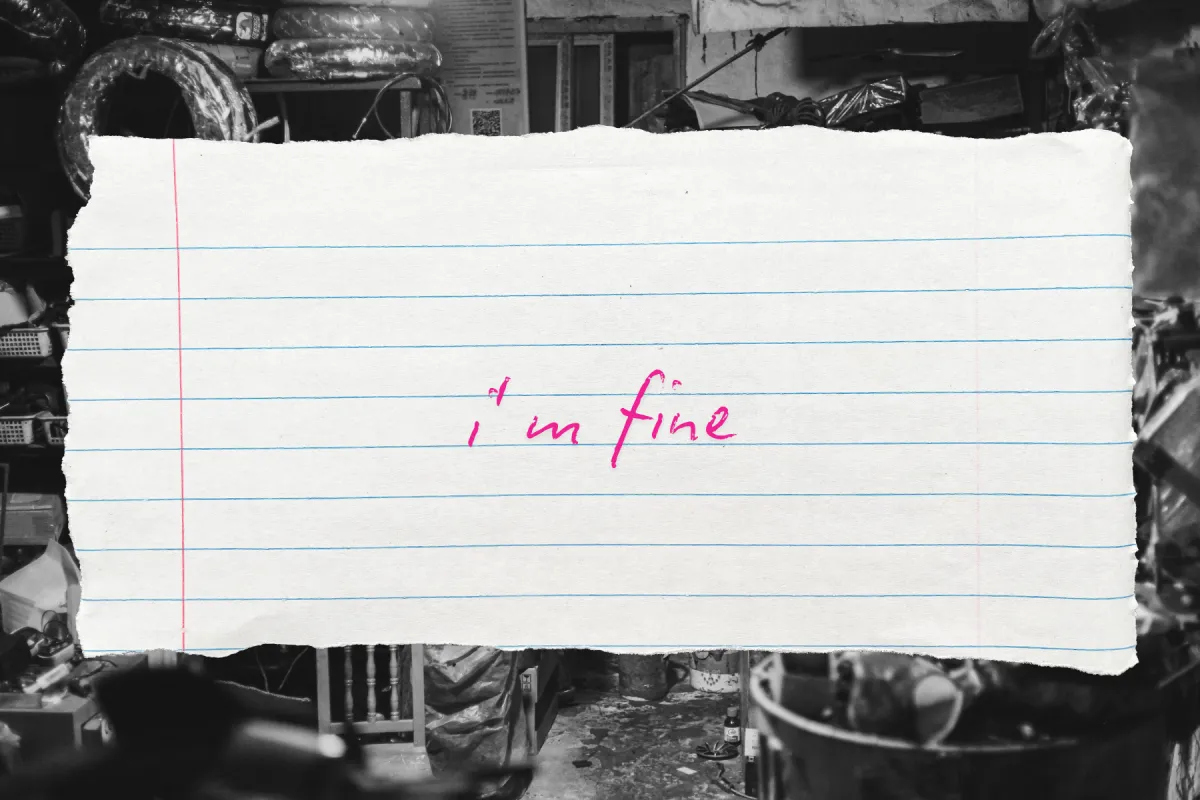
The Pressure to Be Fine Is Exhausting
At some point, you learned to say you were fine before anyone actually asked.
Not because you were lying, exactly. But because saying you were fine was easier than the alternative. Easier than explaining, easier than worrying someone, easier than watching their face try to figure out what to do with what you just said. Fine became a reflex. A buffer. A small, polite door you could close before anyone walked through it.
The problem with that reflex is what it costs over time.
Fine Is a Full-Time Job
Maintaining the appearance of fine takes real energy. It requires constant monitoring. How are you coming across right now? Does anyone suspect that you're barely keeping it together, or does the exterior hold? Is the smile landing the way it's supposed to?
This is exhausting in a way that doesn't show up in any job description. There's no overtime pay for performing okay when you're not. There's no acknowledgment that emotional management is work, real, tiring, daily work, and that doing it alone while also doing everything else takes something out of you.
Most women are remarkably good at it. Which is not a compliment. It just means most women are carrying something that nobody sees.
The High-Functioning Version of Not Okay
High-functioning anxiety is an odd phrase because it almost sounds like a superpower. You're functioning. You're high-functioning, even. How bad can it be?
Pretty bad, actually. And the particular cruelty of it is that because you keep showing up, because the work keeps getting done and the dinners keep getting made and the emails keep getting answered, nobody around you has any real information. They see someone who appears to have it handled.
Inside, it tends to sound more like: I can't stop. If I stop, everything falls apart. I can't let anyone down. I can't show that I'm struggling or people will worry. Or worse, they'll think less of me. Or worse still, they'll try to fix it, and then I'll have to manage their discomfort on top of my own.
So you keep going. Because keeping going is, in a strange way, less exhausting than the conversation you'd have to have if you stopped.
What Gets Lost When You Swallow It
There's a particular kind of clarity you lose when you spend too long suppressing what you actually feel. It gets harder to identify what's bothering you, and then harder still to know what you need. You become a very efficient machine for getting through the day, and a somewhat lost person underneath it.
People who spend years managing their emotions rather than expressing them often describe a kind of numbness. Not dramatic. Just muted. The highs aren't quite as high. The lows are harder to process because they've been held in so long. The small moments of joy get crowded out by the low hum of everything being slightly too much.
That's not a character flaw. That's what happens when a person goes too long without being able to say the real thing out loud.
The Relief of Saying the True Thing
There is a specific kind of relief that comes when you finally say the thing you've been carrying.
Not when someone solves it. Not when you get advice or a reframe or a list of action items. Just when you say it, and someone hears it, and the thing is now in the room instead of only in your body.
It doesn't fix everything. Nothing fixes everything in a single conversation. But something releases. The grip loosens slightly. The thing you've been white-knuckling through gets to exist outside of you for a moment, in language, in air, in the presence of another person who isn't trying to make it go away.
People often leave listening sessions describing a feeling they can't quite articulate. Lighter, they usually say. Like something they didn't realize they'd been holding finally had somewhere to go.
You Don't Have to Be in Crisis to Deserve Space
One of the biggest barriers to being honest about how you're doing is the belief that you haven't earned the right to say something. That you'd need to be worse off, further gone, more clearly struggling before it counts.
That's not how it works.
You don't have to hit a wall to deserve a room that listens. You don't have to be broken to benefit from being heard. Ordinary life, the regular weight of it, the mid-year accumulation of everything you've been managing in silence, that's enough. That qualifies.
The pressure to be fine is real. But you don't have to carry it alone.
You're allowed to put it down for an hour. I'll be here when you do.